What Family Offices Really Want
Interestingly, the homeowners and family offices I work with rarely ask for more meetings or additional reports.
What they usually want is much simpler.
They want confidence that the principal's priorities are being addressed.
They want to know that staffing challenges are being managed and that service levels remain consistent.
They want assurance that someone is paying attention to mechanical systems, technology, human resources, and operational risk.
They want to know that the operating budget is protecting and enhancing the property's value.
And perhaps most importantly, they want fewer surprises related to staffing, projects, and cash flow.
In other words, they want a leader with a plan.
Over the years, while coaching Estate Managers and Directors of Residences, I began noticing the same pattern.
Our conversations rarely centered around the house manual, the maintenance calendar, or the household management system. Instead, we discussed the day's crisis. A difficult employee. A delayed project. A budget concern. A frustrated principal. A contractor issue.
As we worked through these situations, I found myself drawing the same line on paper over and over again. Below the line were the daily frustrations: explaining, complaining, and blaming. Above the line were the activities that actually improved the operation: solving problems, creating systems, and preventing issues before they occurred.
What I realized was that many estate leaders spend most of their time below that line.
Not because they lack experience, not because they aren't working hard, and certainly not because they don't care. They're in the weeds because private service has a way of pulling people into the details.
A staff member resigns. A vendor fails to perform. A project changes scope. A principal shifts priorities. Another unexpected expense appears. Eventually, the entire role becomes a reaction. At some point, I began telling clients, "Let's get back up to the mountaintop." Or, as I often describe it, let's return to the 30,000-foot view.
Because when you're standing in the weeds, every problem feels urgent. Everything feels important. Everything feels immediate.
From the mountaintop, however, something different happens.
You begin to see patterns, identify priorities, and recognize which issues are symptoms and which are root causes. You stop reacting and start planning.
When you're in the weeds, you're trying to fill an open position. From the mountaintop, you're developing a staff retention strategy.
When you're in the weeds, you're explaining another budget overage. From the mountaintop, you're building next year's operating budget.
When you're in the weeds, you're responding to today's maintenance emergency. From the mountaintop, you're planning capital improvements and proactive equipment replacement.
When you're in the weeds, you're managing another difficult conversation. From the mountaintop, you're setting expectations, establishing accountability, and fostering communication.
And when you're in the weeds, you're solving today's emergency. From the mountaintop, you're preventing next year's.
The Estate Managers I coach are rarely unaware of the issues. They know which projects have stalled, which employees are struggling, where communication breaks down, and which systems need attention.
The challenge isn't awareness. The challenge is finding time to step away from the demands of daily operations and think strategically about the future.
That realization eventually became FRAME™.
Not another training program. Not another certification. Not another collection of operational tools.
FRAME™ is a two-day executive planning session designed to give estate leaders something they rarely have enough of: uninterrupted time to think, prioritize, and plan.
Participants leave with a strategic roadmap for the estates they manage—a plan that aligns priorities, creates accountability, and provides clarity for principals, staff, family offices, and vendors alike.
FRAME™ was designed to help estate leaders step away from the weeds and return to the mountaintop: to assess the operation, identify priorities, create accountability, and build a plan.
While developing the FRAME™ workbook, everything I had been teaching about the mountaintop suddenly became tangible. I struggled to visualize how all these ideas, exercises, and planning tools would come together into a format that could be shared with others.
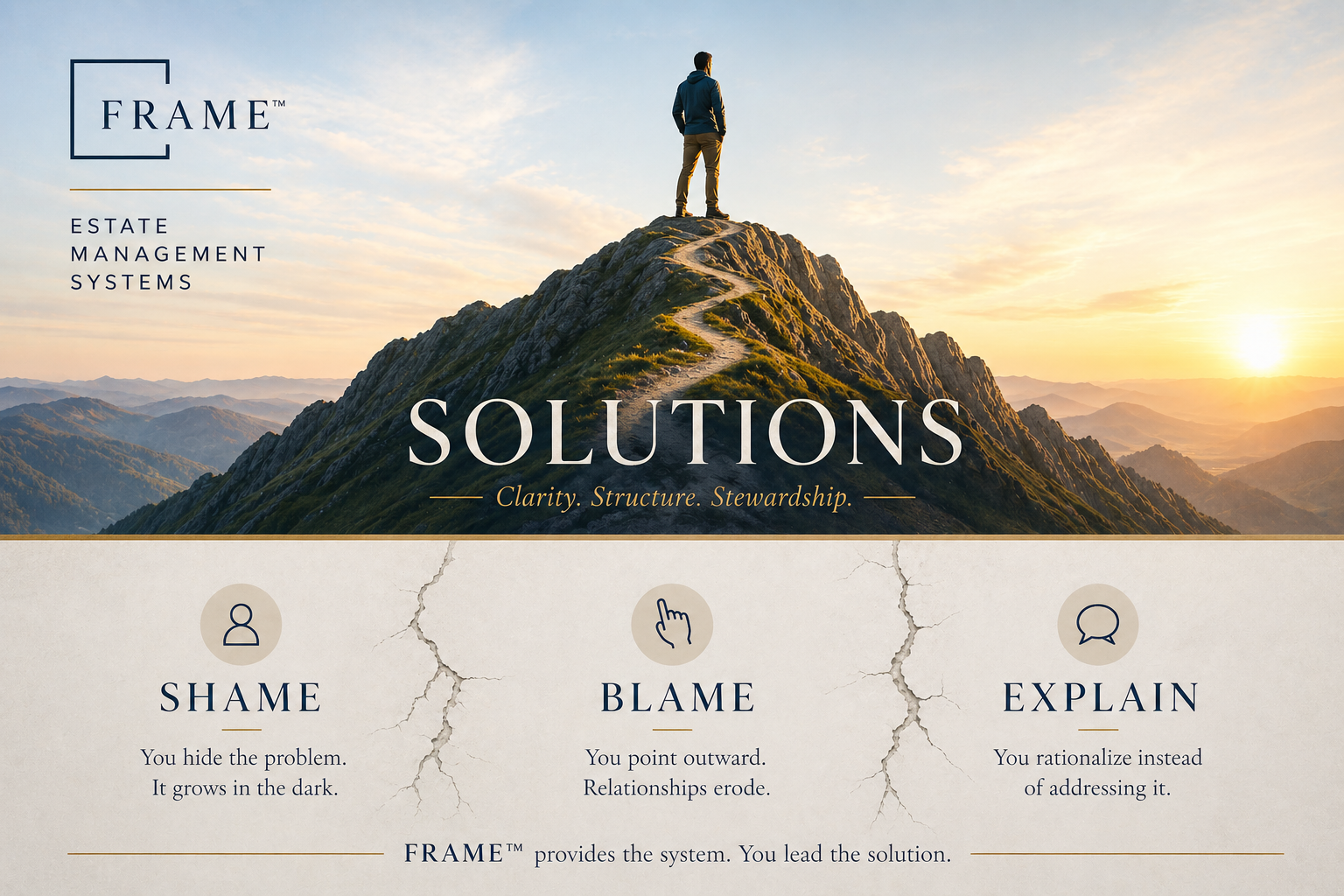
I uploaded many of those concepts into ChatGPT and asked it to create an image. The result was surprisingly accurate: a lone figure standing on a mountaintop, looking down at the path below.
Today, that image appears on the cover of the FRAME™ workbook because it perfectly represents what the program is meant to achieve: stepping away from the weeds long enough to see the operation clearly.
As a reminder to climb back up to the mountaintop when the weeds start to take over, I've included the image below as a downloadable print for your office.
Because when you're in the weeds, it can feel like your problems are unique. From the mountaintop, you begin to realize that others face similar challenges, that solutions exist, and that there is a way forward.